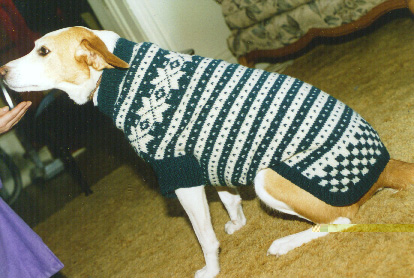
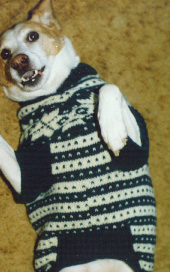
| [ Esther's Knitting Page ] | [ Esther's Patterns & Articles ] |
All comments are welcome! Please let me about your success or problems in using this pattern. Please include your dog's breed and neck & chest measurements as this will help determine how robust the pattern really is. I can be reached via email at ebozak@cs.oswego.edu.
NECK:
Using the needles chosen for the ribbing, cast on the number of sts needed
for your dog's neck measurement (measurement 4a plus ease). Place a marker
between the first and last stitches of the round. Work rounds in ribbing
of your choice for 1-2 inches or desired length of neck ribbing.
YOKE:
Round 1: Changing to largest sized needles, work all sts in K, increasing
evenly to 70-75% of total maximum number of stitches you will
need based on your dog's chest measurement (measurement 4b plus
ease).
Round 2: Work even in desired pattern stitch.
Round 3: Work in pattern increasing 1 st after the round's first stitch
and one st before the round's last st.
Repeat Rounds 2 & 3 until you have achieved the total maximum number of sts needed. [The percentage you use in Round 1 will depend on the depth of the yoke (measurement e) and the number of increases you will need to make in this area to achieve the total number of sts. You should plan your increases such that the total max. number of sts has been reached preferably by the time the yoke is completed, or no later than within the first two rows of the leg openings section. Adjust the % increased to in Round 1 accordingly.]
At the same time, when you have reached the desired depth to the front legs' underarms (measurement 4e), cast off for the leg openings as follows: work 9.5% after marker (1/2 of underside section between legs), cast off 8% for leg opening, work 65% for back section, cast off 8% for second leg opening, and work remaining 9.5% sts to end of round. (Round up/down where necessary, keeping the same number of stitches for the two leg openings and centering the back section sts and the underside sections each between the two legs.)
LEG-OPENINGS SECTION:
This next section can be worked as back and forth as two separate sections
(back and underside) or with steeks over the leg openings -- your choice.
If you decide to work as 2 separate sections, you may attach a second ball
and work the back and underside simultaneously, or you may work one at a
time, being careful to work the two sections for the same number of rows.
This is especially important if you are using any pattern stitch other
than stockinette st; the sections' patterns must match when they meet up
again.
If you have decided to use steeks, on the next round, cast on 5 sts over each leg opening for the steek.
Working either in rows or rounds, continue in pattern over the back and underside sections for a length equal to the front leg's width (measurement 4c plus ease). It doesn't hurt to knit a couple extra rows/rounds for ease if you feel you want a bit more.
If using steeks, bind off the steek sts on the last round worked; if working rows, back and forth, begin rounds again at this point.
CHEST SECTION:
Work in pattern and over each leg opening, cast on the same number of
stitches you cast off for the opening. Work even until sweater length
reaches the bottom of the rib cage/sternum (measurement 4f plus ease).
Next round: Cast off 22% of the stitches for the belly stitches.
BACK SECTION:
Again, you may work the rest of the sweater back and forth in rows, or you
may work in rounds, using a steek over the belly stitches.
Round/Row 1: Work even in pattern. If working in rounds, cast on 5 sts
for the belly steek.
Round/Row 2: Dec one st each side edge; use SSK at beginning of
round/row and K2 tog at end.
Round/Row 3: Work even in pattern.
Repeat Rounds/Rows 2 & 3 until 55-56% of total max. sts are left for the lower back. Work even until sweater length, as measured along the center back line, equals 1 inch and 5 rows less than total desired length (measurement 4g). If working rows, end such that right side is facing.
Next round/row: SSK, work to last 2 sts, K2 tog.
Repeat this round/row 4 more times. If using a steek, bind off the steek sts on the last of these rounds. Cut yarn and place remaining sts on a holder. Alternately, you may simply bind off all remaining sts.
Cut any steeks open.
BELLY GUSSET & BACK RIBBING:
Hold the sweater belly up & with right side facing. Using circular needles
of the size selected for the ribbing, starting at left-hand side edge,
pick up 1 st per row along side, k sts at lower back edge from holder to
needle, and pick up 1 st per row along right hand side edge.(If you have
cast off the lower back edge sts, then pick up 1 sts per sts along this
edge instead.)
Continuing, pick up 1 st for each cast-off sts at the underside -- these sts will be referred to as the belly sts, and the rest of the sts, the side sts.
Place a marker one st after the first belly st and one before the last belly st picked up.
Row 1 (Wrong side): Work in desired ribbing across *belly sts only*. As you
work this row, adjust the number of sts by decreasing when necessary
so that the resulting number of sts is an appropriate multiple +
1/2 multiple for your ribbing st AND that you end with P sts on
each side. (These end belly sts will be K sts on the right side.)
For example, if you are using a K2,P2 ribbing, you will need a
multiple of 4 + 2 sts and the ribbing will be done as: K2; *(p2,k2);
repeat from * to end. For K1,P1 ribbing, you will need an odd
number of sts, and the ribbing will be knit as: K1, *(p1,k1), repeat
from * across.
Row 2: Turn work to right side; with yarn behind, sl 1 side st from
right-hand needle to left, K2 tog, rib to st after 2nd marker, SSK
(last belly st and next side st on left needle.)
Row 3: Turn work to wrong side; with yarn in front, sl 1 side st on
right-hand needle to left, P2 tbl, work in ribbing to st after
2nd marker, p2 tog (last belly st and next side st on left needle.)
Repeat Rows 2 & 3 for 1" for small dogs, 1.5" for medium dogs, 2" for large dogs, or until desired gusset length is reached. (The gusset should be long enough to cover the "hollow" immediately below the dog's sternum.) End after a Row 3 has been completed.
Turn work to right side. Begin working in rounds, ribbing across all
belly and side sts as follows:
Round 1: Sl 1 side st from right to left needle, K2 tog (belly st and
slipped side st), rib across belly sts to st after 2nd marker,
SSK (last belly sts and next side st), rib across all but the
last side st, adjusting side st count to be an appropriate
multiple for your ribbing pattern.
Round 2: K2 tog (last unworked side st and first belly st), rib across
belly sts to st after 2nd marker, SSK, continue around side sts
maintaining ribbing as established to last side st.
Repeat Round 2 until side ribbing is 1" in length (1/2" for small dogs.) Bind off all sts loosely in ribbing.
SLEEVE:
Using the needles chosen for ribbing, pick up 1 st per row and 1 st per
cast-off st around leg opening. Work in rounds in the ribbing st you've
selected, adjusting (by decreasing) the number of sts to be an appropriate
multiple for your ribbing st. When sleeve length is approximately 3/4"
from desired total sleeve length (measurement 4d), switch to the needles
selected for the cuff. Continue ribbing until desired total sleeve length.
Bind off in ribbing.
Repeat for second sleeve. Be sure to adjust the number of stitches, if necessary, to be identical with the number of stitches used in the first sleeve.
Now knit first cuff round as follows: Work in ribbing until you reach the 1st k1,p1,k1 sequence for a 2-st dec, sl 1 knitwise, k2 tog, PSSO (3-st sequence has now been decreased to one k st). Continue ribbing around, performing 2-st decreases at planned points. At end of round you should have only about 75% of original number of sleeve sts left and the ribbing should still be in "perfect" k1,p1 sequence. Continue work on reduced number of sts until desired sleeve length. Bind off.
ALTERNATE SLEEVE #2:
Pick up sts around sleeve opening. Work in same pattern stitch as used for
sweater body (or some related variation to it) until ready to begin cuff.
Switch to smaller needles for cuff and work in desired ribbing st around,
decreasing evenly to about 75% of total number of sleeve stitches on the
first round of ribbing. Make sure you end up with an appropriate multiple
for the ribbing st you wish to use. Work cuff in ribbing until sleeve is
desired length. Bind off.
(Yes, I am implying you make at least *2* sweaters for your dog. If she/he is anything like mine, she/he'll get one wet playing in the snow and then want to go back out before the sweater has time to dry. Just like a kid, who always needs several pairs of mittens for this same reason. :-)
SUGGESTION #2:
If you are using a K2,P2 ribbing, when you are working on the first round
involving all the belly and side sts, you may find the ribbing will lie
flatter if you increase one st between each of the sts you picked up over
the area of the rounded corners.
SUGGESTION #3:
Write down all measurements (both actual and those resulting after adding
in the amount of ease you used), type of yarn used, sizes of needles used,
gauges, st/row counts, inches/rows actually knit in sections, etc.
Anything that you may need to make your dog a second sweater and have it
fit as well or better. This will save you a great deal of time if you
decide to use this pattern for your dog or someone else's.