
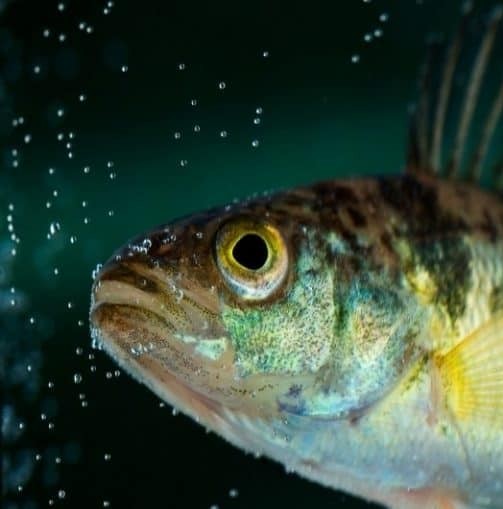
An Ecosystem Under Pressure
The Great Lakes are an economic and ecological powerhouse, supporting a $7 billion fishing industry. But a silent, steady change is putting it all at risk. Average winter ice cover has been declining for decades across all five lakes—a clear sign of a warming climate. This abiotic shift has a cascade of effects on the ecosystem.
The Biological Puzzle

Scientists noticed that as the ice vanished, populations of key native fish, like Yellow Perch (Perca flavescens), began to struggle. They saw a link, but couldn't be sure what was causing it. To solve this puzzle, you need to understand a few key scientific concepts. Click each term below to reveal its definition.
Phenology
The study of the timing of natural events in the lives of plants and animals, like when birds migrate, flowers bloom, or fish spawn. Climate change can disrupt this timing.
Ectotherm
An animal that relies on the external environment to regulate its body temperature (i.e., "cold-blooded"). Fish are ectotherms, so changes in water temperature have a huge impact on their bodies.
Correlation vs. Causation
Just because two things happen at the same time (correlation) doesn't mean one caused the other (causation). Scientists need experiments to strongly support causation.
Explore Further
Watch these short videos to deepen your understanding of phenology.
Designing the Experiment
To test if the correlation was real, the scientists in the Farmer et al. study designed a controlled experiment. They needed to compare a "normal" winter to a "climate-changed" winter. They used historical data to make their experiment realistic:
The "Long Winter"
107
This was the average number of days the water was below 5°C in Lake Erie from 1994-2010. It represents a typical, historical winter.
The "Short Winter"
52
This was based on the winter of 1999, one of the warmest on record. It represents a realistic short, warm winter scenario.
Your Mission: The Egg Viability Lab
It's your turn to be the scientist. Use the simulation below to investigate the link between winter duration and egg size.
Field Notes
Female ID
Capture Year
Winter Duration days
Measurement Log
Instructions: Measure 10-20 eggs from this female, then load a new sample. Repeat for at least 10 females.
| Egg ID | Diameter (mm) |
|---|
For Teachers & Collaborators
Interested in the full lesson plan and student worksheets? We have analog options, including printable PDFs of petri dishes with simulated eggs. Click the button below to request access or share your feedback.
Request Teacher Resources